
AI continues to dominate conversations across the media and events, but at our Breakfast Exchange event in early May, we wanted to explore what it actually means for the future of businesses, particularly employers, employees and any business to change their ways of working.
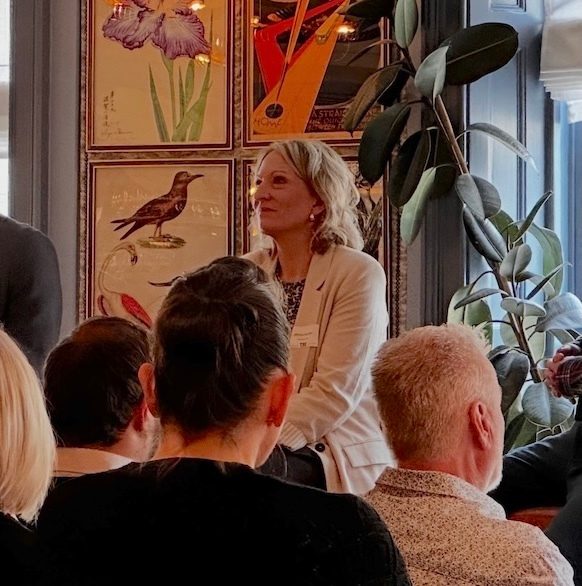
The panel was chaired by Anita Jaynes, founder of The Business Exchange, who posed questions to Richardson Swift’s Managing Director, Debbie Boulton, alongside fellow experts Richard Jaggs, Founder and Director of Resolution Design, Natalie Ward, Partner of the Employment Team at Thrings, and Alex Bacon, Founder of Brightkeel AI.
One thing was clear throughout the discussion: for competitive advantage, businesses should be moving beyond simply asking whether they should engage with AI and instead focus on how they can use it to create added value for clients, whilst also ensuring it is used responsibly and ethically.
AI is changing roles, not simply replacing people
One of the strongest themes from the discussion was that AI isn’t at the point of replacing jobs right now. Instead, businesses are beginning to rethink workflows, responsibilities and where people add the greatest value.
In fact, Alex Bacon has built an already successful business around this idea. His company, Brightkeel AI, works with businesses to identify where AI can add the most value across their processes, helping them build practical AI and automation roadmaps.
In particular, the panel discussed repetitive administrative and process-driven tasks, where AI can support efficiency and free up resource for the value-add work.
For businesses built around advice, service and relationships, this is especially relevant. Increasingly, clients expect not only technical expertise, but also responsiveness, insight and a more personalised service. And when making decisions around their finances and wealth, clients need to trust their adviser - ultimately, it’s all about relationships, which AI can never replace.
Used well, however, technology has the potential to support this by helping teams work more efficiently while allowing more time to focus on client relationships and strategic advice.
At Richardson Swift, our chartered accountants, tax advisers and business advisory specialists see AI and technology as tools to enhance the way we support clients, not replace the people behind the advice.
Businesses need a more strategic approach to AI
Another key takeaway was that many businesses are still in an experimentation phase.
The challenge is no longer whether to engage with AI, but how to do so in a way that is commercially useful, responsible and aligned with the business.
An interesting point raised during the discussion was the importance of breaking down services and operations into individual process stages, so that businesses can identify where different AI tools and techniques can add value, whether through efficiency, support or improving the client experience.
This is likely to become increasingly important as businesses move beyond ad hoc use of AI and towards more structured adoption.
Human skills may become even more important
Perhaps surprisingly, the discussion repeatedly returned to the growing importance of human skills.
While AI can support analysis, automation and content generation, it cannot replace empathy, judgement, trust and relationship-building, all of which remain central to professional and advisory services.
In many ways, the panel suggested that AI may actually increase the value of these skills, particularly as technical tasks become more automated. This is likely to have implications not only for businesses and recruiters, but also for how future generations are prepared for the workplace.
For firms like Richardson Swift, this reinforces an important principle: great accounting, tax advice and strategic business support are not just about technical accuracy. It is also about understanding people, supporting clients and building long-term relationships.
Governance, oversight and ‘Shadow AI’
The panel also discussed the risks associated with rapid AI adoption.
Many businesses still do not have policies and governance around AI usage, despite employees increasingly using AI tools in day-to-day work, often without oversight or formal processes in place. This was referred to during the discussion as “Shadow AI”.
Examples were shared of AI-generated outputs containing inaccurate or misleading information, highlighting the continued need for human review and accountability.
One particular point raised was that AI should be treated like another member of the team, with processes in place as you would with any employee, including:
- Clear role parameters
- Review processes
- Regular oversight
- Sign-off procedures
As AI tools become more embedded within businesses, governance and quality control are likely to become increasingly important.
What does this mean for future talent?
The discussion also explored how AI may reshape recruitment and the skills businesses value in future employees.
Increasingly, alongside technical skills, organisations will look to prioritise:
- Adaptability
- Flexibility
- Curiosity
- Willingness to learn
- Confidence with technology
This is particularly relevant for younger people entering the workplace and raises important questions around how the education system prepares future generations for an evolving world of work.
The panel also highlighted that entirely new roles and career paths are already beginning to emerge as businesses adapt to AI and other technologies.
AI should be viewed as an opportunity
Perhaps the clearest overall takeaway from the event was that AI should not simply be viewed as a cost-cutting exercise. Instead, businesses should consider how technology can help improve services, strengthen client experience and support smarter ways of working.
While much of the discussion focused on strategy, people and the future workforce, AI and automation are already creating practical solutions for businesses today. From cloud accounting software and automated bookkeeping processes to smarter financial reporting and management information, technology can help businesses save time, improve accuracy and gain better visibility over performance.
At Richardson Swift, we believe the firms that will succeed in the future are those that combine strong human relationships and trusted advice with a willingness to embrace innovation. We work closely with our clients to identify the right systems, processes and technologies to streamline finance functions, improve efficiency and support future growth – without ever losing the human touch.
Technology will continue to evolve rapidly, but the businesses that benefit most are likely to be those that approach AI thoughtfully, strategically and with a clear understanding of where it genuinely adds value.
As businesses continue to adapt to new technologies and ways of working, having the right commercial, financial and strategic advice will be increasingly important.
Whether you are looking to improve efficiencies, automate finance processes or book-keeping, or plan for future growth, the Richardson Swift team would be happy to help. We offer a range of services for businesses or individuals - find out more below.